
Which bob suits my face shape?
Updated: October 2026
Determine your face shape in a few steps, then choose the length and edge of your bob to match the effect you want. This guide covers the five face shapes, the five most important types of bob and tips on bangs and parts. All advice here is a rule of thumb; in the end, your hair texture, your everyday routine and your own taste are what count.
All women shown are AI-generated and entirely fictional.
The short answer: how to find your bob
First, determine whether your face is longer than it is wide, whether your forehead, cheeks and jaw are about the same width, or whether one area stands out. Then choose the length and edge shape of your bob so that it either echoes or balances that area. As a rule of thumb: if you want to emphasize lines, go for clean, straight edges. If you want softer transitions, go for layers, waves or a side part. Either way, it's a matter of taste, not a rule.
| Face shape | Worth trying (rule of thumb) | Bangs and part |
|---|---|---|
| Oval | Many styles, such as a classic bob or a French bob | To taste |
| Round | Long bob, A-line bob, light layers | Side-swept bangs or a side part |
| Square | French bob, softly layered bob, long bob with waves | Soft, wispy bangs |
| Heart-shaped | Classic bob or A-line bob at chin to jaw length | Side-swept or long, soft bangs |
| Oblong | Chin-length bob with volume at the sides, waves | Straight or slightly curved bangs |
You'll find the reasoning in the sections below. No face shape is better or worse than another. It's simply about the effect you want.
Determine your face shape in two minutes
All you need is a mirror and a pen that writes on glass, or a photo taken from the front. Pull your hair back so your forehead and jaw are visible, and look straight into the mirror.
- Length vs. width: Compare the height of your face (hairline to chin) with its width at the cheekbones. If the height is only slightly greater, that points to oval; if your face looks noticeably elongated, to oblong. The line between them is fluid. If both measurements are similar, you're leaning toward round or square.
- Look at your forehead: If it's the widest part, that points to heart-shaped. If it's about as wide as your cheeks and jaw, that suggests square or oblong.
- Look at your cheekbones: If they stand out as the widest point and your face tapers softly toward the chin, that points to oval or round.
- Trace your jawline: If it forms a clear angle, that's a sign of a square face. If it follows a soft curve, it's more likely round or oval. If it tapers to a point at the chin, that fits heart-shaped.
- Trace the outline: Use the pen to trace the outline of your reflection, then step back. The shape you see is your starting point.
- Photo instead of a mirror: Take a photo of yourself from the front at eye level from about one meter away, not a close-up selfie, which distorts faces.
The five face shapes and what balances or emphasizes each one
Choose the shape below that comes closest to yours. Each section names the telltale feature, suitable types of bob and a tip on bangs and parts. This information is based on our editorial rules of thumb, not hard-and-fast rules.
What shape is your face?
Choose a shape above.
Oval
How to recognize it: The face is slightly longer than it is wide, the cheekbones are the widest point, and the forehead and chin are similarly narrow and softly rounded.
Suitable bob styles: Many. That isn't an advantage; it just means there is less to weigh up. The classic bob, the French bob and the long bob leave the proportions as they are. A blunt bob highlights the calm overall shape especially clearly.
Bangs and part: Anything goes. Straight bangs, side-swept bangs or none at all: the only thing that matters here is what feels right to you. A center part and a side part both look balanced.
Round
How to recognize it: Length and width are similar, the cheeks are softly rounded, the jawline follows a soft curve, and the forehead tends to be low.
Suitable bob styles: A long bob or an A-line bob cut slightly longer in front visually elongates the lines. If you like softness, you can choose a classic bob with light layers. A straight blunt bob exactly at chin level, on the other hand, emphasizes the roundness.
Bangs and part: Side-swept bangs or front pieces that fall along the cheeks often have a lengthening effect. A side part brings a diagonal line into the face, while a very straight center part with a smooth surface makes the roundness more visible.
Square
How to recognize it: The forehead, cheekbones and jaw are similar in width, and the jawline is strong and forms a clear angle.
Suitable bob styles: A French bob or a classic bob with soft, lightly layered ends softens the edges. A long bob with waves has a similar effect. A blunt bob with a sharp line at jaw level emphasizes the geometry. That is a deliberate choice for anyone who likes the contrast.
Bangs and part: Soft, wispy bangs or strands that fall into the face at the sides round off the contour. A side part looks softer than a center part.
Heart-shaped
How to recognize it: The forehead is the widest area, the cheekbones are pronounced, and the face narrows toward the chin.
Suitable bob styles: A classic bob or an A-line bob at chin to jaw level adds volume in the lower area and balances the width at the top. A long bob with waves works in a similar way. A blunt bob looks clean and severe, which can be very flattering with this shape.
Bangs and part: Side-swept or gently curved bangs soften a wide forehead. Long, soft bangs or a side part can also take the focus off it. Short, straight bangs emphasize the forehead area.
Oblong
How to recognize it: The face is clearly longer than it is wide, the forehead, cheeks and jaw are similar in width, and the chin is often rather square or round.
Suitable bob styles: A bob at chin level or just below with volume at the sides, such as a French bob with waves or a classic bob with layers, adds width. A long bob is more of a second choice here: sleek lengths down to the collarbone make the face look even longer, but with waves and volume at the sides it works better.
Bangs and part: Straight or gently curved bangs visually shorten the length of the face. A center part with sleek lengths emphasizes length, while a side part with volume looks wider.
Bob styles at a glance
The word “bob” covers several cuts that differ mainly in length, edge shape and layering. You can find a detailed explanation of the terms in the guide Types of bob haircuts explained. Here are the five most important ones compared.
| Style | Length as a rule of thumb | Edge | Bangs and part |
|---|---|---|---|
| Long Bob | Collarbone (slightly below shoulder-length) | Straight or lightly layered | Side part or center part, wispy bangs or none |
| Classic bob | Chin | Straight to slightly rounded | Center part or side part, straight or side-swept bangs |
| French bob | Chin to jaw | Soft, often slightly wavy | Short bangs are typical, part tends to be casual |
| A-line bob | Shorter in back, chin-length or longer in front | Angled longer toward the front | Side part or center part, bangs are rare |
| Blunt bob | Usually chin to jaw | Sharp, without layers | A center part or straight bangs work well |
The length guidelines are rules of thumb. The hair length converter works out roughly how many inches or centimeters a reference point such as the chin or collarbone corresponds to. Salons don’t all use these terms the same way, so it’s best to bring a picture to your appointment. You’ll find out how to prepare in the guide Preparing for your salon appointment.
Same figure, four lengths: what length changes
The slider shows a figure from our episodes in four lengths, from her starting length to a jaw-length bob. Drag the slider and watch how the frame, outline and overall effect on the face change. In the first image, the hair is worn down and long with a center part. The face stays the same, but from the second step on, bangs are added, and hair color, expression and top change too. So the comparison shows tendencies rather than the effect of length alone.
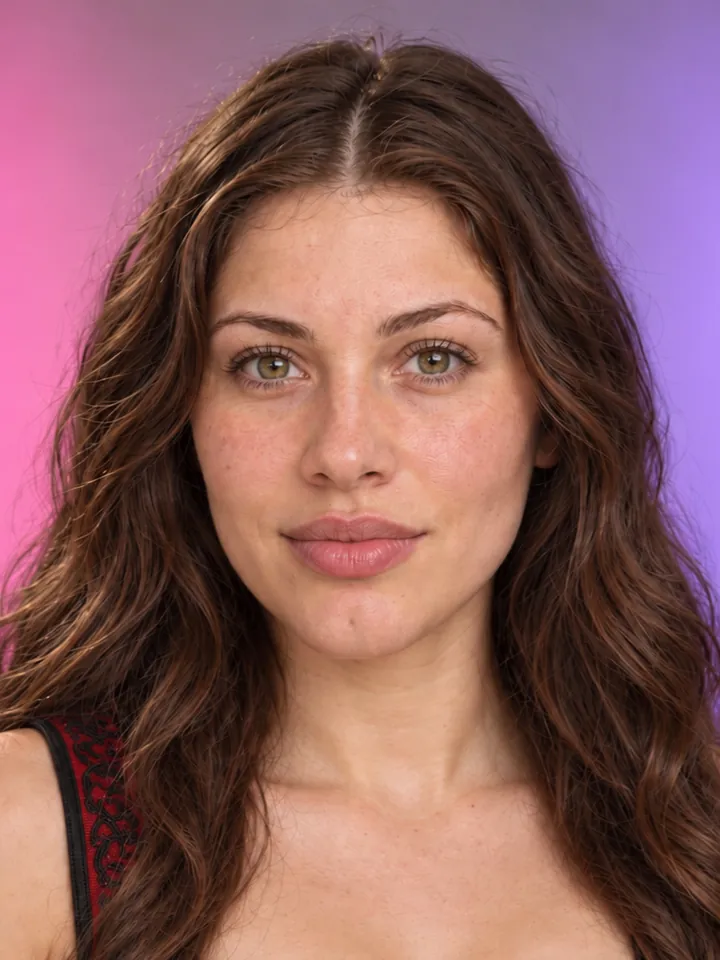
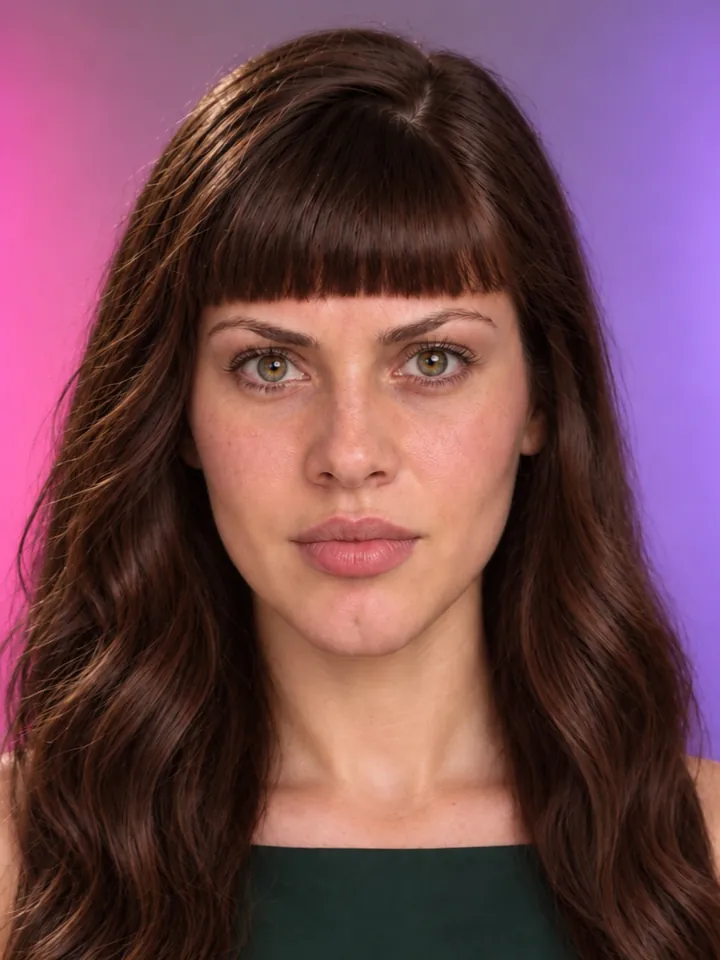
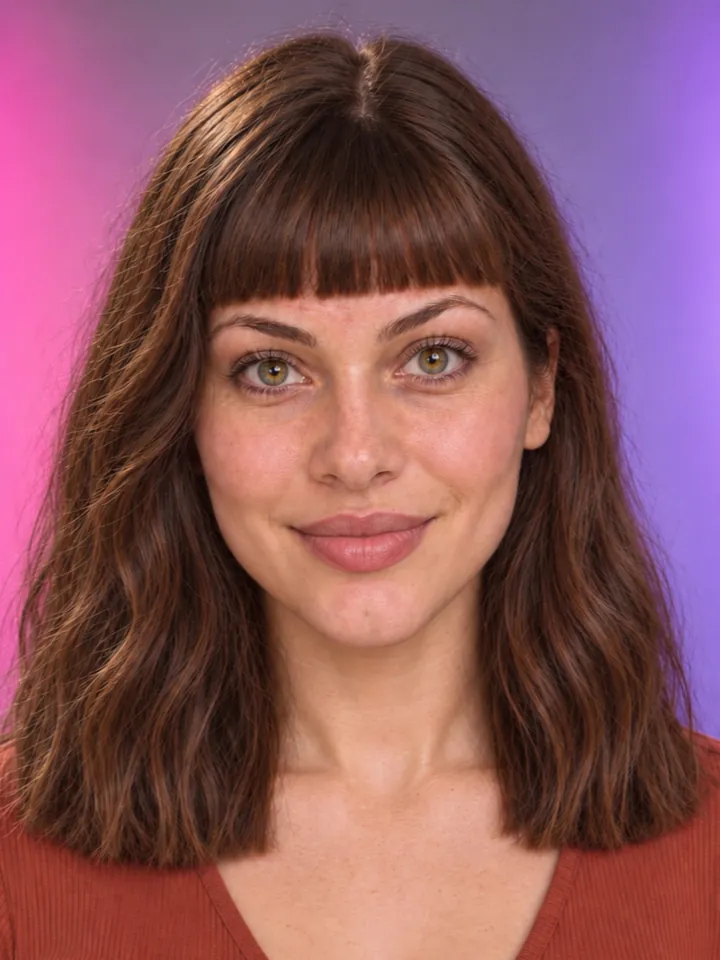

With long hair, the lengths frame the face and make it look narrower. The shorter the cut, the more the jawline becomes the focus, because the bottom edge of the hair now sits at its level. That’s why a few centimeters more or less can shift which part of the face is emphasized; choosing the length is often just as important as choosing the style.
Examples from the episodes: edge, bangs and length
Two more fictional, AI-generated figures show how different a bob around the jawline can look. They are meant only to illustrate haircuts, not as a recommendation for any face shape.
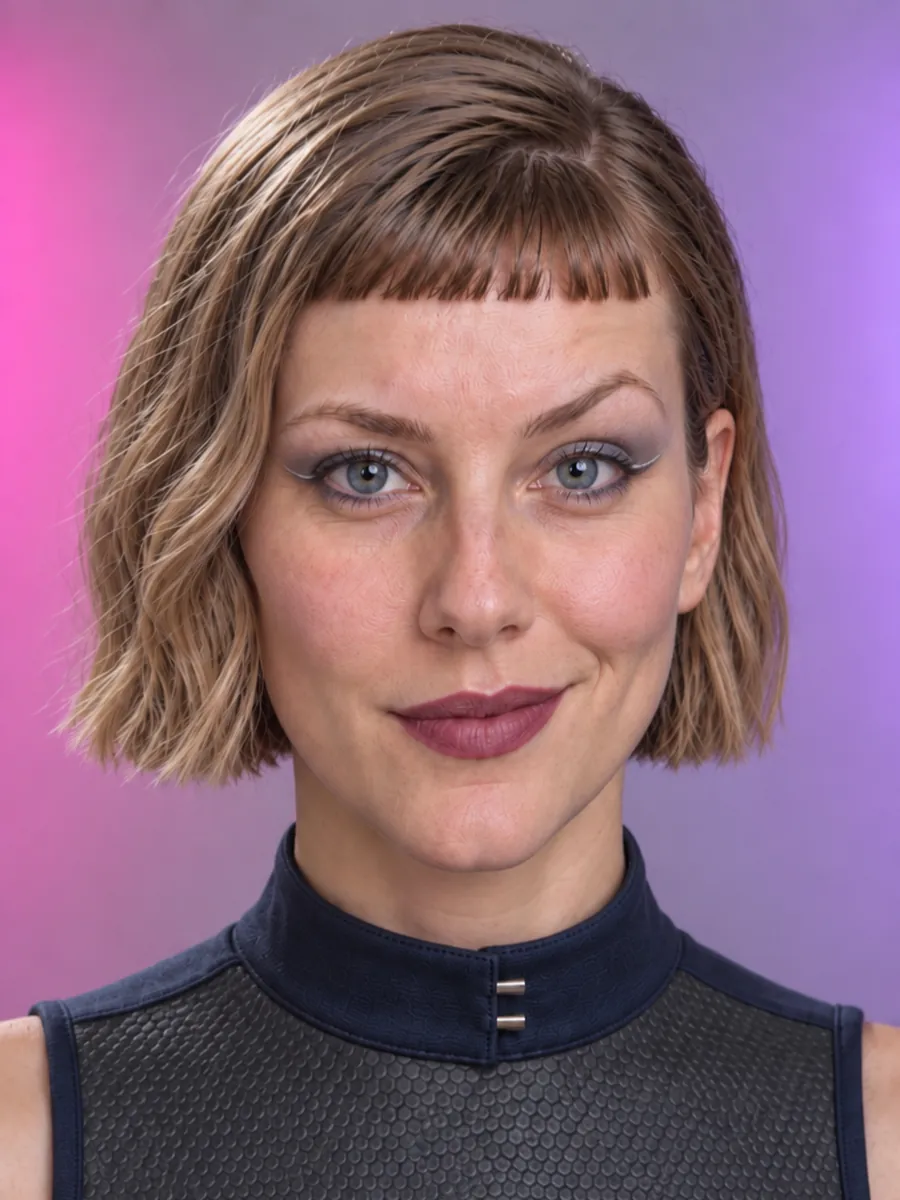
Estela’s bob is all about its soft, irregular ends. The edge is still visible, but the ends are wavy. The very short bangs are cut unevenly and end well above the brows. This is a style close to a French bob.
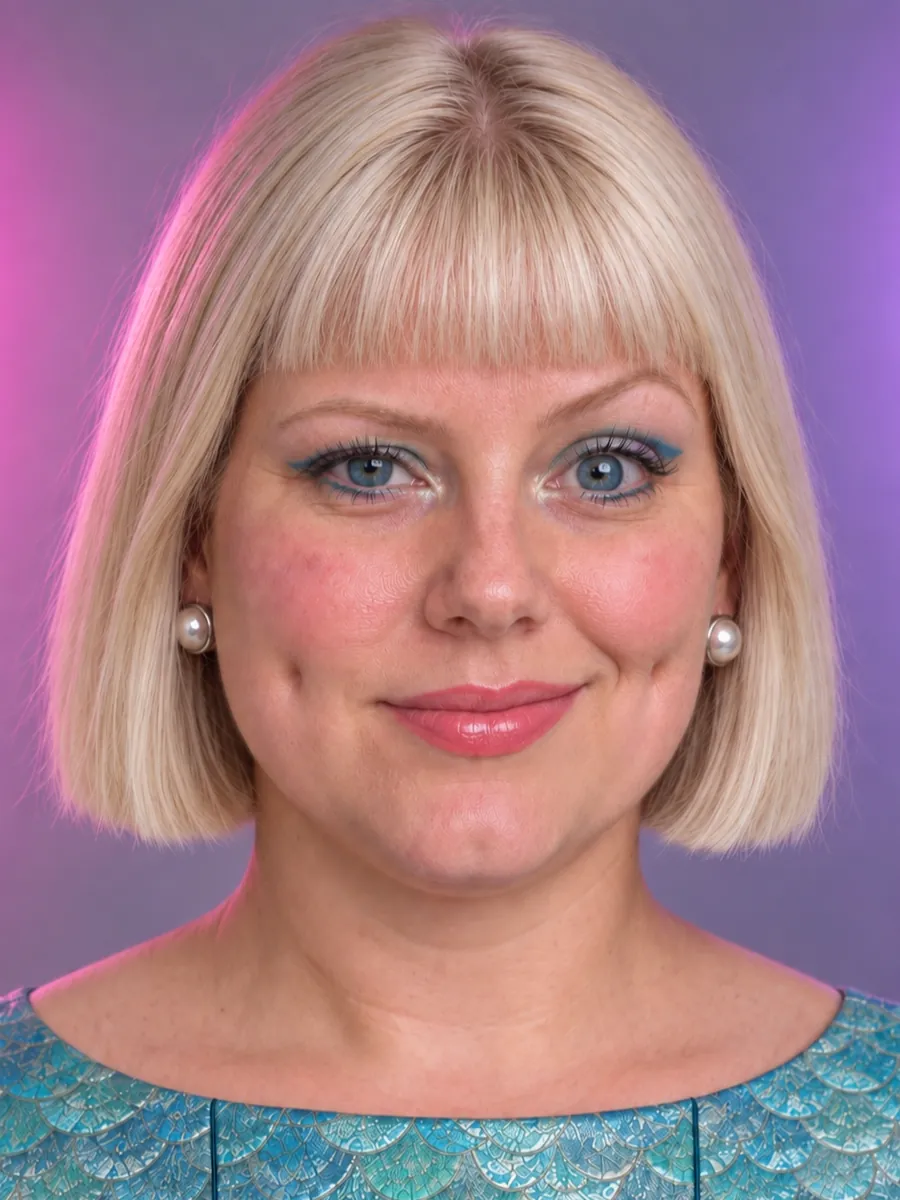
Ingrid’s cut, by contrast, is all about clean lines: sleek, a sharp edge, full bangs. That’s the blunt bob direction. Both bobs end between the jaw and chin, yet edge, texture and bangs create completely different impressions. You’ll find more before-and-after examples on the page Short Bob: Before and After.
Bangs and part: the two small adjustments
Bangs and part often change the look of a bob more than the difference between two styles, and they’re usually quicker to adjust than the length, for example by switching your part or sweeping your bangs to the side.
- Straight, full bangs: Emphasize the eyes and forehead line and look clean and graphic. They need regular trims, as a rule of thumb every few weeks.
- Side-swept bangs: Look softer and grow out easily. They suit many face shapes and can be pinned to the side when needed.
- Wispy bangs: Let some forehead show through and look lighter; a good choice for fine hair.
- Center part: Looks symmetrical and calm, and emphasizes the center of the face and its length.
- Side part: Adds asymmetry and volume on the parted side, and often looks softer and livelier.
- No bangs: If you’re unsure, you can start with a bob without bangs. You can always add bangs later.
When the rule doesn’t apply
Matching a cut to your face shape is a starting point, not a law. Several other factors often have just as much influence on how a bob looks and how well it works day to day.
- Hair texture
- Very fine, straight hair holds a straight edge well. Curly or coily hair often looks shorter after the cut; how to bring this up at the salon is covered in the guide Preparing for your salon appointment. Thick hair can spread out a lot in a blunt bob; in that case, some light thinning helps, which you can discuss at the salon.
- Hairline and cowlicks
- A cowlick at the forehead or a pronounced hairline can make straight bangs tricky. The way the hair grows at the nape also affects how the back edge sits.
- Glasses
- Bangs and the arms of your glasses compete for the same space. Bring your glasses to your appointment so the length and bangs can be planned around them.
- Daily routine and personal taste
- If you're short on time in the morning, a low-maintenance cut is worth more than the style that fits best in theory. And if you like a shape that the rule of thumb doesn't recommend, that's your call.
Your next steps
- Determine your face shape using the steps above.
- Note two or three suitable styles from the selector and find a reference photo for each.
- Decide on bangs and part, and check your hair texture, hairline and daily routine.
- Prepare for the consultation: read the guide Preparing for your salon appointment and bring the photos with you.
If you're still unsure about the basic question, the page Should I cut my long hair short? offers help with the decision. If you'd like to go from long hair to your goal hairstyle in stages, you'll find the route in the guide From hip-length to a bob.
FAQ
Can I determine my face shape myself?
Yes. You can trace the outline with a mirror and a pen, or take a photo of yourself straight on from about one meter away. Mixed shapes are common, so treat the result only as guidance.
Which bob suits almost every face shape?
As a rule of thumb, a classic bob or a softly layered bob looks balanced on many faces. Whether it suits you, though, also depends on your hair texture, bangs and daily routine.
Does a bob need bangs?
No. A bob works with or without bangs. If you're unsure, start without them and decide later, since bangs can always be cut afterward.
What's the difference between a classic bob and a blunt bob?
A classic bob can be slightly rounded or layered, while a blunt bob has a sharp, straight edge with no layers. Both are often worn at a similar length.
What if the rule doesn't match the cut I want?
Then your taste is what counts. Discuss what you want at the salon so the length, edge and bangs can be adjusted to make the cut work for your hair.
Does hair texture really matter?
Yes, often about as much as face shape (rule of thumb). Curly hair often looks shorter after the cut, very fine, straight hair carries a straight edge well, and thick hair sometimes needs thinning.
More guides
- Types of bob explained
- Preparing for your salon appointment
- From hip-length to a bob
- Pixie cut guide
- Caring for and styling short hair
- Growing out without frustration
- Hairstyles through the decades
- All guides at a glance
All packs with filters by hairstyle and hair color
The guides are no substitute for personal advice at the salon.