
Pixie cut guide: who it suits, how to style it and when to trim
Updated: October 2026
A pixie is a short cut with very short sides and nape and a little more length on top. It suits many hair types when the cut is built around your hair's texture, and it often needs an appointment every four to six weeks. This guide shows the variations, helps you with a self-test and explains styling, trims and alternatives.
In brief: what a pixie is
A pixie is a short cut in which the hair at the sides and nape is kept very short, and the ears are usually fully or partly exposed. On top, a little more length remains that can be laid flat, lifted or combed to the side. The interplay of short sides and textured top is what defines the cut. Below you can see what that looks like day to day.
All images on this page come from our before-and-after packs. The characters are fictional and AI-generated; we describe only hairstyle and hair color. You'll find a collection of complete transformations under Pixie cut: before and after.
Pixie, bob and other short haircuts: how they differ
In everyday use, the terms often get mixed up. Looking at the length at the nape and around the ears is a helpful guide.
| Cut | Sides and nape | Typical feature |
|---|---|---|
| Pixie | very short, ears usually exposed | length only on top, lots of texture in the top section |
| Long Pixie | short to medium, ears partly covered | longer top, often reaching the eyebrows or beyond |
| Short bob and bob | end at ear level (very short bob), jaw level (short bob) or chin level (bob) | continuous outline all around the head |
The key difference from a bob: a bob has a continuous edge around the head, while a pixie gets longer from the sides toward the top. If you're on the fence between the two, the section on alternatives below shows two in-between options.
The variations at a glance
A pixie isn't a single cut but a whole family. The variations overlap: a pixie can have bangs, a longer top and an exposed nape all at once. Each tab shows where the emphasis lies. Choose a variation below to see it on an example from our packs and read what matters most.
Which pixie variation would you like to see?
Choose a variation above.
Classic pixie
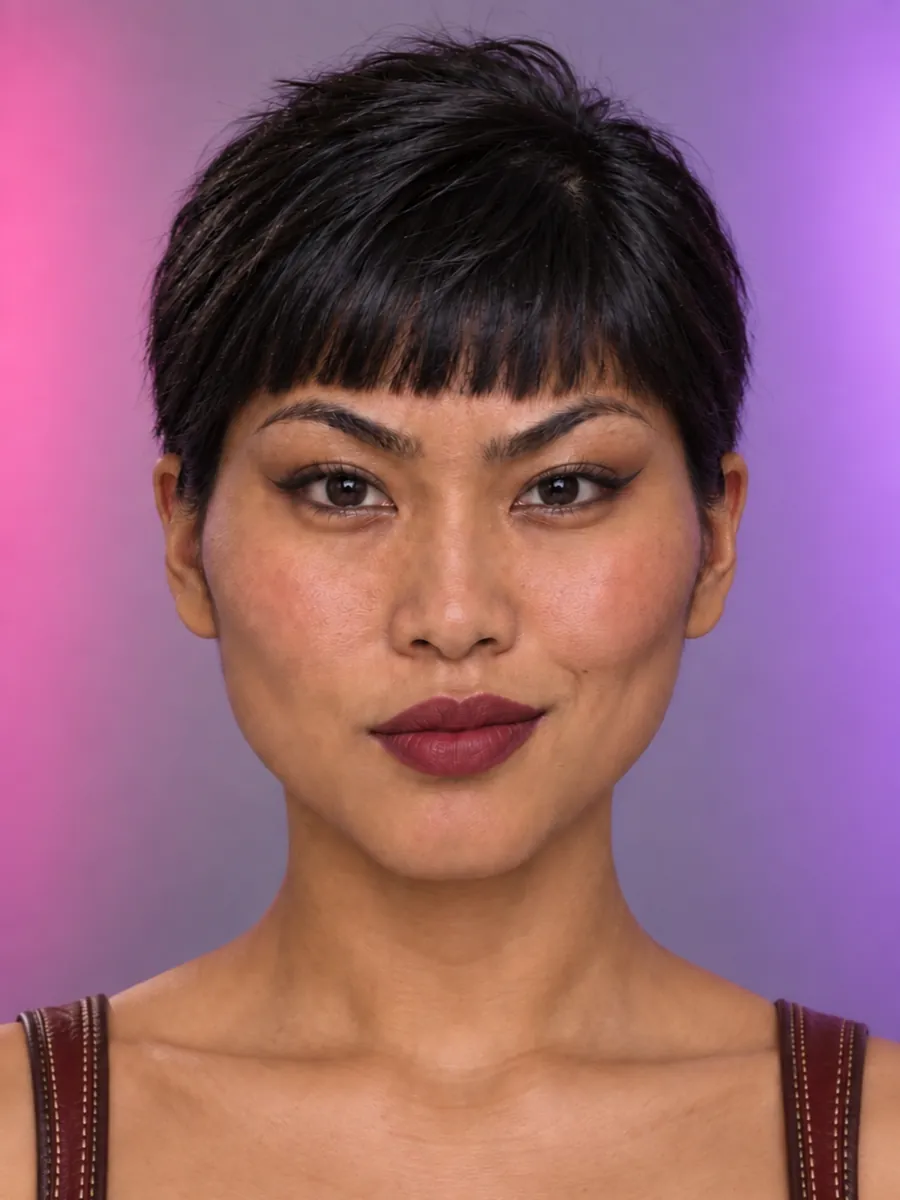
The classic pixie has short sides, a short nape and a slightly longer top that usually falls in one direction. It's the basic shape from which the other variations are derived. It needs regular upkeep of the outline but can be styled in just a few moves.
Pixie with bangs

Bangs frame the face and shift attention to the eyes. They can be cut straight, side-swept or wispy. Good to know: bangs get noticeable faster when they grow too long, because even one centimeter (0.39 in) changes the line above your eyes. That's why a quick in-between appointment just for the bangs is often worth it.
Pixie with longer top

Here, more length is left on top. That gives you options: you can slick the hair back, comb it to the side or loosely push it up. The cut looks less severe and grows out more evenly, because the transition to a long pixie is seamless.
Soft pixie

The soft pixie works with layered, less sharp edges and makes use of natural waves or curls. It looks gentler than the classic shape and suits hair that already has some movement.
Pixie with exposed nape
With this variation, the hair at the nape is cut especially short and clean, so the nape line stays visible. A front-facing photo can't show this line; ask to see it from the side and from behind at the salon. In our packs, the exposed nape is part of every final pixie cut; bangs and top hair vary from character to character. The trade-off is maintenance: an exposed nape line loses its shape faster than a longer outline.
Which hair types a pixie works for
The short answer: more than many people think, as long as the cut is built around your hair texture. The longer answer depends on four points.
Fine hair
Fine hair often benefits from a short length, because without the weight of long strands it shows more volume. Visible layers on top help. Mallory from our catalog had fine, straight, hip-length hair before the cut and wears a pixie with an exposed nape and a longer top afterward. That's an example, not a promise: only a consultation at the salon can show how a cut will behave on you.
Thick hair
Thick, dense hair holds a pixie's shape very well, but it needs thinning and texture on top so it doesn't stick out at the sides. Imogen from our catalog had thick, straight hair and wears a pixie with short, straight bangs afterward.
Wavy and curly hair
Natural waves and curls are often an advantage with a pixie, because they give the top hair volume and movement on their own. Mention in advance that your hair will spring up a bit after the cut, since curls shrink shorter than they look when wet. A soft pixie is often the obvious choice here, as with Greta, whose hair was curly before the cut.
Cowlicks and hairline
A strong cowlick at the nape or crown changes the direction your hair falls. A good hairstylist cuts with the cowlick rather than against it and shapes the bangs or top hair accordingly. Point out the spot at the salon and ask how the cut will be adapted to it.
Self-test: Is a pixie right for me?
Five questions about your daily routine, how you feel about showing your ears and nape, willingness to maintain, styling and curiosity. From top to bottom, each answer scores 0, 1 or 2 points, for a maximum of 10 points. Your hair texture is deliberately not part of the score, because a pixie can be cut for almost any texture. The test gives you a starting point for your conversation at the salon, not a verdict on your looks.
Is a pixie right for me?
Styling in just a few minutes
A well-cut pixie needs little styling. As a rule of thumb, one to five minutes is enough, depending on the version. Pat it towel-dry, blow-dry the top in the direction you want (sides on a low setting), and work a pea-sized amount of texturizing product into the ends: that's usually all it takes. Shape your bangs and ends with your fingers, not a brush.
Pixie looks thrive on texture, not perfection. A slightly tousled look is intentional. You'll find more tips and everyday routines in the guide Caring for and styling short hair.
Trims: how often do you need one?
A pixie loses its shape faster than long hair because just a few millimeters at the sides and nape are noticeable. As a rule of thumb, trims are spaced three to seven weeks apart, often four to six, to keep the outline and bangs in shape. If you wear longer hair on top, slightly longer intervals work too. Many salons offer a quick outline trim between full appointments; ask about it. The haircut appointment calculator shows how many appointments that adds up to per year.
For context: as a guideline, hair grows about 1 cm (about 0.39 in) a month; for the range between fast and slow, we calculate with roughly 0.5 to 1.5 cm (about 0.2 to 0.6 in). This is an assumption, not a measurement. It explains why a pixie already looks different after a month. The hair growth calculator does the math for your pace.
When it grows out
It usually takes many months for a pixie to reach bob length: using the guideline of 1 cm (0.39 in) a month, this shop's hair calculators estimate about 7 months to ear level and about 15 months to chin length. Hairstyle guides sometimes quote 6 to 12 months for the way to a bob. Both are rough estimates; hair grows at different rates, and shaping cuts along the way cost some length. So the transition doesn't have to be frustrating. The key is in-between cuts that shape the sides and nape while the top is allowed to grow longer. How to do this step by step is explained in the guide Growing it out without frustration. For your own estimate, use the hair growth calculator.
From long hair to pixie: the four lengths
A pixie doesn't come out of nowhere. Imogen from our catalog, a fictional, AI-generated character, goes through four stages: hip, collarbone, chin and finally the nape. With the slider, you can see all four lengths in sequence and picture how the overall look changes.




The example shows that a pixie can be the end point of a gradual shortening. If you're hesitant, you can stop at chin length and decide later. The step-by-step plan from long hair to a bob is explained in From hip-length to a bob.
Decision help and alternatives
If you're still undecided after the quiz and the examples, three questions can help: Are a few minutes of styling in the morning enough for me? Am I willing to schedule an appointment every few weeks? And can I live with a clearly visible change if the result turns out differently than expected?
If you answer no to any of these questions, there are in-between options that come close to the overall look:
- Long Pixie
- The sides and nape stay short, while the top is noticeably longer and can be styled. Upkeep stays manageable, and the outline is more forgiving.
- Short bob or bob
- A very short bob (ear level), a short bob (jaw level) or a chin-level bob has the freshness of a short cut but grows out more gracefully. For an overview of the shapes, see Types of bob haircuts explained.
If you're still not sure whether your long hair should go at all, Should I cut my long hair short? can help. And before you book an appointment, it's worth reading Preparing for your salon appointment.
FAQ
How often does a pixie cut need a trim?
Three to seven weeks is typical, often four to six; these are rules of thumb from hairstyle guides, not a fixed rule. With a longer top, slightly longer intervals are also possible.
Which hair types suit a pixie?
Fine, thick, wavy and curly hair, as long as the cut is built around your texture. A consultation at the salon will show which variation works best for you.
How long does styling take?
As a rule of thumb, one to five minutes, depending on the variation and your hair texture. A slightly tousled look is intentional with a pixie.
How is a pixie different from a short bob?
A bob has a continuous edge around the head, while a pixie gets longer from the sides toward the top. With a pixie, the ears are usually exposed.
Can I grow out a pixie again?
Yes, with in-between cuts for the sides and nape, the transition is smoother. This shop's calculators estimate about 15 months to chin length; hairstyle guides sometimes quote 6 to 12 months. Shaping cuts along the way cost some length. You'll find more in the guide to growing it out.
More guides
- Which bob suits me?
- Types of bob explained
- Preparing for your salon appointment
- From hip-length to a bob
- Caring for and styling short hair
- Growing out without frustration
- Hairstyles through the decades
- All guides at a glance
All packs with filters by hairstyle and hair color
The guides are no substitute for personal advice at the salon.