
How to prepare for your haircut appointment: photos, questions, glossary
Updated: October 2026
With reference photos, a named point on your body such as your chin or collarbone as your goal length, and an honest description of your hair, you walk into the salon well prepared. A checklist, a length slider and a glossary help you speak the same language as your stylist.
In short: pictures, words, questions
A good haircut appointment starts at home. Bring several reference photos, name the length you want at a point on your body (such as “chin” or “collarbone”), describe your hair honestly, and clarify in advance how much time and money the cut will take. Then both sides know what they are talking about. If all you say beforehand is “a little shorter,” you often get something different from what you pictured – not out of carelessness, but because “a little” means something different to everyone.
Below you will find a checklist to tick off, a length slider for illustration and a glossary of the words you hear all the time at the salon. Whether the big cut is even in the cards is covered in the guide Should I cut my long hair short?
Collecting reference photos: what a good picture includes
A photo says more than ten sentences, but only if it shows the right thing. A good reference picture has daylight or even lighting, shows the hair uncovered (not under a hat, scarf or hand) and makes the length, outline and bangs or forehead area clearly visible. Heavily edited pictures with filters, extreme backlighting or a wig-like look are misleading, because you cannot know what the hair looks like without editing.
If possible, collect three views of the same hairstyle: from the front (bangs, face framing), from the side (length at the ear, graduation, layers) and from the back (nape, outlines, length down the back). If that isn’t available, two pictures of different people with a similar cut will do; then say what you like about each one (“the length here, the bangs there”). More than five or six pictures tend to confuse rather than help.
Choose examples from people whose hair is similar to yours, for instance in density, texture and color. A cut on fine, straight hair looks different on thick, wavy hair.
The opposite matters too: bring pictures you don’t like. “Please not like this” is just as useful to your stylist as “yes, like this.” It often quickly reveals what it’s really about – for example, that it isn’t the length you dislike, but the blunt, heavy ends.
The language of the salon: hair lengths and technical terms
At the salon, lengths are often named after points on the body: hip, chest (shoulder blade), collarbone, shoulder, chin, jaw, ear, nape. That is more practical than centimeters, because body heights and head shapes differ. The downside: the words leave room for interpretation. Some people already take “shoulder-length” to mean a length just above the shoulder; we mean the hair rests on the shoulder line. So always point to the spot with your finger on your own body as well – or in the mirror.
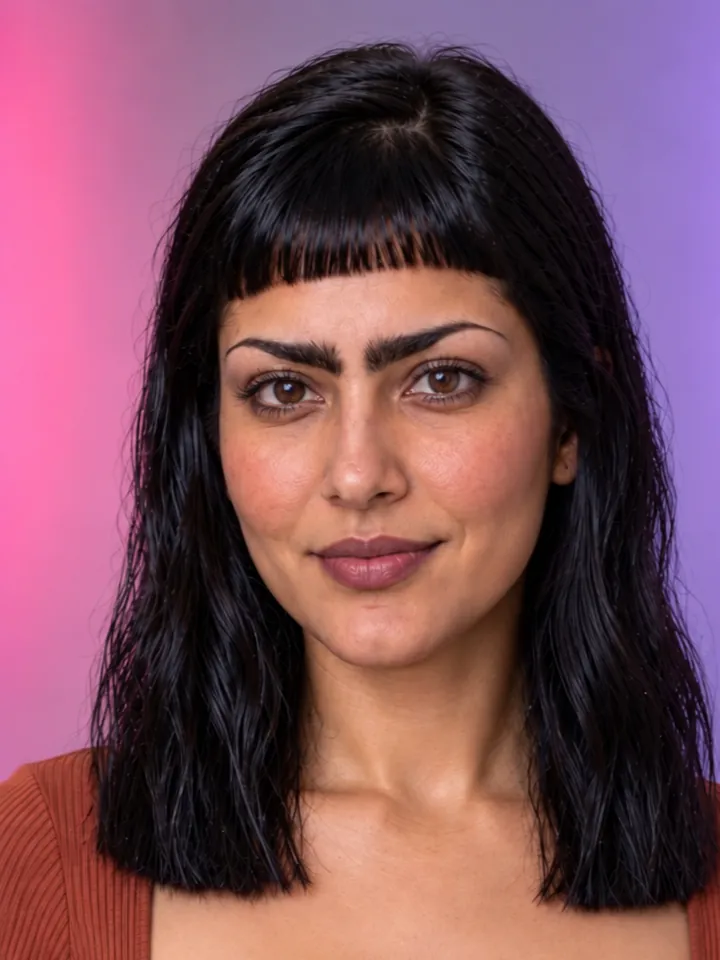
The slider below serves as an illustration. It shows a fictional, AI-generated character from the shop at three lengths; we leave out the in-between chest-length stage. Because the images are portrait crops, you only see the ends of the hair at the shorter stages. The labels follow the character’s sequence of lengths; with the bangs, the overall impression, expression and top change as well, not just the length.


Hair length glossary
The body points from long to short. Our other guides and calculators use the same definitions.
- Hip
- The hair reaches hip level. A very long length where even a cut of several hand widths is possible without it looking short.
- Chest (shoulder blade)
- The hair ends at about the level of the shoulder blades on the back, roughly at chest height. From the front you often only see it down to the chest, so it’s important to clarify the length at the back.
- Collarbone
- The hair ends at about collarbone level, at the top of the chest, usually a little lower than “shoulder.” A popular length often called a “long bob” or “lob.”
- Shoulder
- The hair rests on the shoulder line and touches the collar. When you move, it often flips outward there.
- Chin
- The hair ends at the tip of the chin. This is classic bob territory. Here, just a few centimeters noticeably change the overall look.
- Jaw
- The hair ends along the jawline, between the earlobes and the chin. A short bob at jaw level falls within this zone; clarify the exact length using a photo. There is no separate centimeter value for it.
- Ear (ear level)
- The hair ends at about earlobe level; this is the very short bob. Depending on the cut, the ears are fully or partly exposed.
- Nape
- The hairline at the nape determines how high or low the cut ends at the back. “Exposed nape” means the nape area is cut short and visible.
- Layers
- The hair is cut in different lengths on top of each other, creating volume and movement. A few long layers look soft; many short layers look lively and tousled.
- Outlines
- The visible outer line of the cut, for example at the nape, behind the ears or at the sides. It can taper off softly or be clean and sharp.
- Wispy ends
- Short, often unevenly cut strands at the bangs or ends. Ask whether “wispy” refers to the bangs or the ends.
- Bang width
- The width of the bangs: from temple to temple, only over the eyebrows or narrow in the middle. Show the width you want on the photo or with two fingers on your forehead.
- Thinning
- Thinning shears or a special cutting technique reduce the bulk of the hair without changing the length. Fine hair is usually thinned sparingly or not at all; with thick hair, thinning can tame the volume.
- Roots
- The area right at the hairline and part, where the hair grows out. It determines how much volume you get on top and where the part sits. (In coloring, “roots” means the same area.)
- Hair density
- How many hairs grow on a given area. It is different from hair thickness (fine, medium, coarse) and helps determine how a cut falls.
How many centimeters is that?
As a guideline for a height of 165 cm (about 5 ft 5 in; whole centimeters, approximate), this is the hair length measured straight down from the crown:
| Body point | Hair length from the crown (guideline) |
|---|---|
| Hip | 79 cm |
| Shoulder blade (about chest-length) | 46 cm |
| Collarbone (lob) | 35 cm |
| Shoulder | 31 cm |
| Chin (bob) | 21 cm |
| Ear level, earlobes (very short bob) | 13 cm |
| Exposed nape (pixie) | 6 cm |
Measure straight down from the crown to the body landmark. For hair length, hold the strand at the crown smoothly downward and measure to the tip. The two measurements differ by a few centimeters; the calculator gives an approximation. The difference is about three to five centimeters (about 1 to 2 in), more with layers or curls. For a different body height, the hair length converter recalculates the values. This is a different measure from the cut length your stylist mentions, which is often measured differently. Ask the salon for the number in inches or centimeters. “Jaw” is not a separate row in the table: the jawline lies between ear level and chin.
Describe your hair texture and roots honestly
At the salon, describe your hair as it really is, not as you’d like it to be. Three details help most: hair thickness (fine, medium or coarse), hair density (low, medium or high) and natural texture (straight, wavy, curly). Add any quirks, such as a strong cowlick at the nape, a spot at the roots where the hair won’t lie flat, or a part that always falls to the same side.
Why this matters: the same photo can only be recreated differently with different hair. Waves and curls often spring up as they dry, so the length looks shorter dry than wet. Fine hair usually lies close to the head and nape, while coarse or very thick hair tends to stick out. A stylist can plan for this, but only if the information is accurate.
Also explain how you style your hair in the morning and which treatments, such as coloring or perms, you’ve had. If you have five minutes and never blow-dry, you need a different cut than someone who sets aside time to style every day.
An example from the catalog: Sorcha’s starting hair is long, loosely wavy and blue-black; the sequence of lengths went from the hips to chest-length and collarbone down to a jaw-length bob. Especially with wavy hair, the question “How will it look dry?” is a good starting point, because the wave only shows more clearly in shorter layers.
Questions for the salon, time and price
Questions for your stylist
A consultation before the first cut is normal. Good salons take time for it and, at the end, sum up in their own words what will be cut. These questions can help during the conversation:
- “What length exactly are you cutting, and where does it end when wet and when dry?”
- “Does this cut suit my hair texture and density, or does it need adjustments?”
- “How much care and styling time will this take every morning?”
- “How long will the shape last, and when should I come back for a trim?”
- “Is there an in-between length in case I'm unsure?”
- “What will the cut cost in total, including washing, blow-drying and any thinning?”
Listen to the stylist's questions, too. If the salon looks critically at your photo and raises concerns, that isn't a refusal; it's expertise. Then ask: “What would be a similar option that works better with my hair?” And it's better to say “Please show me the length at my chin” than to wonder after the cut what was meant.
Plan for time and cost
As a rule of thumb, a bigger cut takes longer than simply trimming the ends. Appointments are often quoted at 45 to 90 minutes, with about an hour being typical (a rough guide, not a fixed standard; ask about the scheduled time when booking). For a major change with a detailed consultation, expect the upper end, and coloring adds more time. When booking, ask whether extra time is planned for long hair or a makeover cut, and allow for a buffer.
Prices vary widely from salon to salon and often depend on hair length, effort and the stylist's experience. Ask for the total price in advance and find out what it includes; if you're quoted a “starting at” price, ask for specifics. The time and money calculator for short hair shows how appointments and costs add up over a year.
Checklist before your appointment
The following list sums up your preparation. You can check off items, copy the list or print it; your browser remembers the checkmarks.
My checklist before the appointment
- Save three to five reference photos: front, side and, if possible, back
- Add one or two pictures I don't like and note why
- Show the desired length on my body and note the reference point (e.g., chin, collarbone)
- Write down hair thickness, density and natural texture
- Note special features: cowlicks, part side, spots where the hair won't lie flat
- Note how much time I have for styling in the morning
- Write down my most important questions for the salon
- Ask about total price and duration when booking
- Plan a time buffer for the appointment
- Decide on a plan B: an in-between length or a point where I want to stop
- For the day after the cut: set aside time for photos from the front, side and back
Plan B: if you're unsure
It's perfectly fine not to be sure. In that case, agree on an in-between length in advance: you stop short of your goal, say at the collarbone instead of the chin, live with it for a few weeks and then decide on the next step. How to go in stages is explained in the guide From hip-length to a bob; you can see the sequence itself in our four-step episodes, as well as in Short bob: before and after.
For choosing reference pictures, see Which bob suits my face shape? and Types of bob haircuts explained.
After the appointment: check, style, adjust
Take your time looking at the result from all sides in the salon, using two mirrors. Does the length match the reference point you discussed? Is the bangs width right? How does it look dry? Photograph your freshly blow-dried hair from the front, side and back so you have comparison pictures.
If something bothers you after a few days, get in touch. When booking, ask whether small touch-ups are possible after the appointment, for example on the bangs, the outline or the length on one side. Then describe specifically what bothers you, ideally with a photo. If you want to wear your hair longer again later, the guide Growing it out without frustration has tips; the hair growth calculator works out how long it takes (rule of thumb: about 1 cm (0.39 in) a month, different for everyone).
FAQ
How many reference photos should I bring?
Three to five pictures are usually enough, ideally from the front, side and back. Add one or two pictures you don't like.
What's the best way to describe the length I want?
Name a reference point such as chin, jaw or collarbone and also point to the spot on your own body. The same number of centimeters ends in a different place depending on height, so a point on the body is clearer.
What does thinning mean?
Thinning reduces the bulk of the hair without changing the length. With fine hair, stylists usually use it sparingly.
How long does a bigger cut take?
From experience, salons quote 45 to 90 minutes, with about an hour being typical; for a big change with a consultation, expect the upper end. Ask about the scheduled appointment time when booking.
What should I do if I’m unsure?
Agree on an in-between length, such as collarbone-length first instead of chin-length, and decide on the next step after a few weeks.
More guides
- Which bob suits me?
- Types of bob explained
- From hip-length to a bob
- Pixie cut guide
- Caring for and styling short hair
- Growing out without frustration
- Hairstyles through the decades
- All guides at a glance
All packs with filters by hairstyle and hair color
The guides are no substitute for personal advice at the salon.